
Message for the Fourth Sunday in Lent, Year A (3/15/2026)
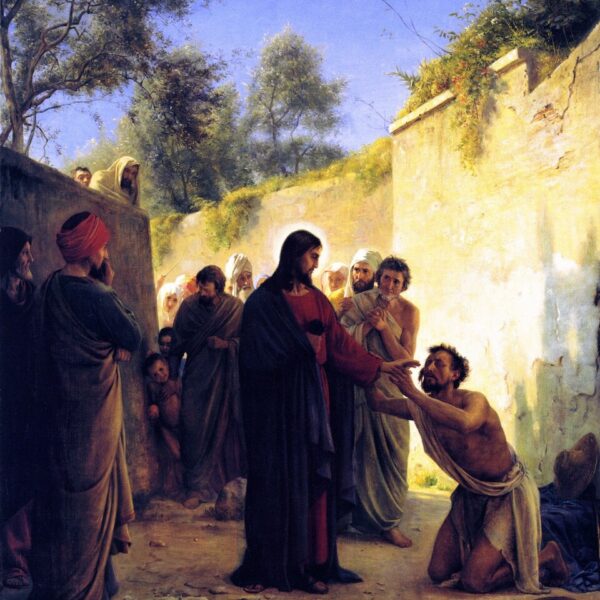
John 9:1-41
“There is only one question [that] really matters.”
That’s Rabbi Harold Kushner’s introductory claim in his best-known book. And the one question that matters is not Who? as in “Who sinned, this man or his parents, that he was born blind?” No, according to Rabbi Kushner, that question rests on a more fundamental question. The only question that really matters is Why? as in Why do bad things happen in the first place? Faced with a constant barrage of troubling news, Kushner asks himself: “Can I, in good faith, continue to teach people that the world is good, and that a kind and loving God is responsible for what happens in it?”[1]
Of course, that’s what Jesus’ disciples are getting at in today’s Gospel when they ask him to explain the blind man’s condition according to sin. They need a neat and tidy theological reason for this person’s apparent misfortune; they need to know why. And of course, Jesus declines to provide such a simplistic explanation. Instead, he replies, “Neither this man nor his parents sinned; he was born blind so that God’s works might be revealed in him.” Which is to say Jesus shifts the disciples’ focus from Why? to How? as in How is God at work in this person’s life?
As an aside, let me point out a common problem with biblical healing stories. Even if we reject the link between blindness and sin, nevertheless we may make faulty assumptions about disability in general. Pastor Brian Krause, who lives with cerebral palsy, recounts the first question he often heard as a child: “What’s wrong with you?”[2] We bristle at the bluntness, but there is an honesty in that question that betrays our tendency to view disability as a defect. Moreover, the Gospels do appear to connect the removal of a person’s disability with their restoration to wholeness, which implies that disability is a condition that needs healing.
But that’s not necessarily the case. Former ELCA Bishop Craig Satterlee, who is legally blind, insists that “many people with disabilities… have larger and more pressing hopes and concerns than getting rid of their disabilities.” In fact, in defiance of the notion that they’re somehow deficient, “people with disabilities are bold to say that they are created in the image of God.”[3]
“Neither this man nor his parents sinned,” Jesus says, “he was born blind so that God’s works might be revealed in him.” Rather than deliberate about the man’s condition, in other words, turn your attention to God’s activity in his life and the impact that has on his community.
Hear how Pastor Robin Meyers treats this subject in chapter 1 of Saving God from Religion. Fair warning: the following reflection includes a reference to child death:
[Excerpts from pp. 23-6]
Friends, when life feels out of control, we naturally want to know why. But perfect understanding will forever elude us in this profoundly imperfect world. And we risk causing further harm when we prop up facile theological reasons for suffering. For his part, Jesus guards against oversimplifying the unknown– “Neither this man nor his parents sinned”– and invites us instead to trust the promise of life abundant and eternal. After all, our great hope is not that God will make sense out of senselessness, but will make resurrection out of death.[4]
[1] When Bad Things Happen to Good People, 6-7.
[2] “Holy Access,” vimeo.com/282241936.
[3] “Learning to Picture God from Those Who Cannot See,” 49-50.
[4] Pastor Tim Brown.
Liturgy © 2022 Augsburg Fortress. All rights reserved. Used by permission under OneLicense # A-706920.
Liturgy © True Vine Music (TrueVinemusic.com). All rights reserved. Used by permission under CCLI license #11177466.