
Message for the Fifth Sunday in Lent, Year A (3/22/2026)
Psalm 130 & John 11:1-45
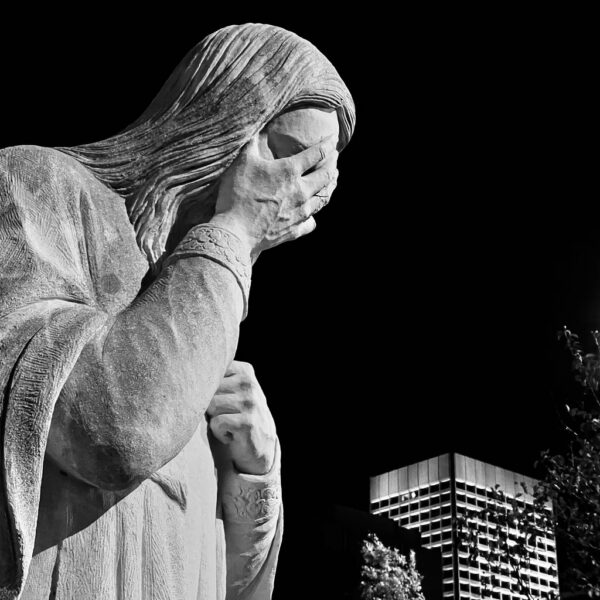
John chapter 11 verse 35 is famously the shortest verse in the English Bible. If, as a confirmation student, for instance, you were required to choose a verse to recite from memory, you could cut corners by selecting John 11:35: “Jesus wept”– or, in the more grammatically accurate and only slightly longer translation we use in worship, “Jesus began to weep.”[1]
And although you might choose that verse out of convenience, it would be an excellent choice nonetheless. How remarkable that Jesus, the one whom John’s Gospel calls the word of God in the flesh, would respond to the death of his friend Lazarus in such an unmistakably human yet divinely compassionate way: “Jesus wept.” If Jesus is “full of grace and truth,” then his weeping is deeply gracious and truthful.[2]
Some interpreters have been embarrassed by this scene, as if Jesus’ behavior somehow undermines the sovereignty of God, as if God should be distant, impassible, untouched by suffering and loss. But I don’t think I can believe in a God like that. Jesus’ weeping implies that God does not stand above life and death, unmoved. The God of Jesus is the God of the cross, the God who literally knows our pain– the pain of love and loss, fear and death.
“Felt reality is invariably wept reality,” writes the mystic Richard Rohr, “and wept reality is soon compassion and kindness…. [Tears] proceed from deep inside, where we are most truly ourselves. Tears reveal the depths at which and from which we care.”
That is not to say tears come easily to many of us. Rohr continues:
Most folks invariably apologize for or try to hide their tears. One wonders why. Do they not want the deep self to be revealed? Perhaps it is because tears are so inexplicable? So out of control? Operating by their own rules? Humiliating? Always! Tears invite participation in a wider world and pull us out of our isolation.
When we cry, we are revealing our truest, most loving self.[3]
Which is to say we’re revealing the self that is made in the image of God. Divine compassion, apparent in Jesus’ own weeping, discloses what Rohr calls the “big secret” of a full life: “that human beings are really made of love and for love. And we still don’t know it! We can only cry it.”[4]
The Psalmist does just that in the psalm assigned for today: “Out of the depths I cry to you, O LORD…!” From the lowest, most deeply felt place– that’s where the faithful turn to God who loves and cares for us, indeed who weeps with us. And that posture of prayer– “from the depths”– captures the truth of our experience in a way that so much prayer does not. As Pastor Robin Meyers explains in chapter 5 of Saving God from Religion:
[Excerpts from pp. 124-5, 134-5]
“Out of the depths I cry to you, O LORD…! I wait for you… my soul waits; in your word is my hope.” Friends, the word of God is a word of compassion. And our hope is that God not only stoops down to share in our suffering, but also lifts us up to share in eternal life. In the end, the God of the cross is also the God of resurrection, the God who will finally call us out of our tombs, like Lazarus, once and for all. And on that day, God will wipe every tear from our eyes, even our tears of joy.[5]
[1] New Revised Standard Version Updated Edition.
[2] John 1:14.
[3] The Tears of Things, 168-70.
[4] Ibid. 172.
[5] Revelation 21:4.
Liturgy © 2022 Augsburg Fortress. All rights reserved. Used by permission under OneLicense # A-706920.
Liturgy © True Vine Music (TrueVinemusic.com). All rights reserved. Used by permission under CCLI license #11177466.
“Jesus is a Rock in a Weary Land”; Arr. © Wyatt Tee Walker
“Here on Jesus Christ I Will Stand”; Text © 2007 East African Annual Conference, admin. General Board of Global Ministries, GBGMusik
English adapt. and arr. © 2007 Greg Scheer, admin. General Board of Global Ministries, GBGMusik
“I Am the Bread of Life”; text: Suzanne Toolan, RSM, b. 1927, based on John 6; music Suzanne Toolan, RSM; text and music © 1966, 1970, 1986, 1993 GIA Publications, Inc. All rights reserved. Used by permission under OneLicense #A-706920.
“Precious Lord, Take My Hand”; text: Thomas A. Dorsey, 1899-1993; music: George N. Allen, 1812-1877, adapt. Thomas A. Dorsey; text and music © 1938, 1966 Unichappell Music Inc., admin. Hal Leonard Corp. All rights reserved. Used by permission under OneLicense # A-706920.
“When We Are Tested”; Text © 1996 Hope Publishing Company, Carol Stream, IL 60188. All rights reserved.