
Home › Sermons › Sing to the Lord, All the Earth
Sing to the Lord, All the Earth
Message for the Twenty-First Sunday after Pentecost, Year A (10/18/26)
Psalm 96:1-10 & Matthew 22:15-22
“Sing to the Lord a new song; sing to the Lord, all the earth.”
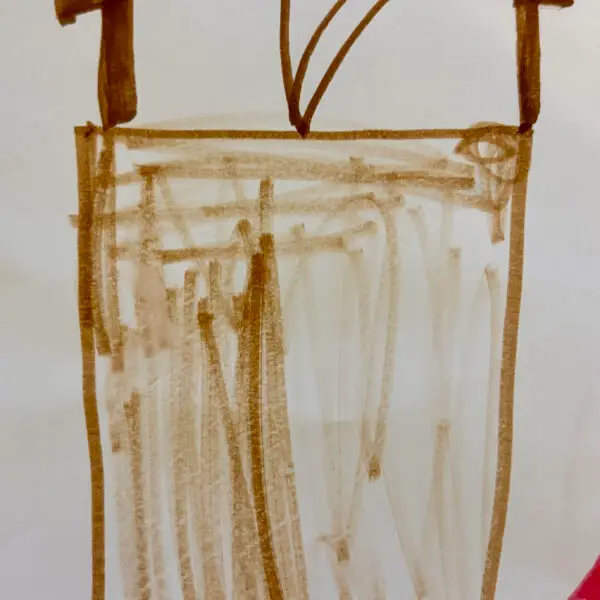
Last Sunday, Kate F. presented this picture to my spouse, Bethany. Children have a way of expressing their experience of church through artwork, and Kate’s drawing is no exception. Notice the twin symbols that set this place apart in Kate’s imagination: crosses on the rooftop corners with musical notes rising between them. Kate gets it: what defines a church in large part is our sacred song, and what defines our song is the way it escapes the sanctuary, transcending the boundaries of our Sunday morning assembly.
Have you ever caught yourself humming a tune on your way home from church, or contemplating a hymn lyric? When we sing to the Lord, our song has a way of settling into our hearts and traveling with us into the world. That is to say, singing is never simply entertainment or edification; singing is proclamation: “Sing to the Lord a new song…. Declare God’s glory among the nations and God’s wonders among all peoples.”
Today’s Gospel from Matthew is all about giving glory. “Teacher,” the religious authorities address Jesus, “we know that you are sincere, and teach the way of God in accordance with truth…. Tell us, then, what you think. Is it lawful to pay taxes to the emperor, or not?”
Of course, this query is in bad faith; Jesus’ opponents intend to stymie him with a question that has no good answer. On the one hand, if he advocates the payment of taxes, he appears to collaborate with Rome, and risks alienating his followers, mostly Jewish commoners who suffer under Roman occupation. On the other hand, if he opposes the payment of taxes, he appears to reject Roman authority, and risks the charge of sedition.[1] It’s a no-win situation, an impossible challenge designed to undermine his legitimacy.
But true to form, Jesus bests his adversaries in the rhetorical sparring ring. His reply to the question about taxes works on multiple levels. First, he sidesteps the trap by giving Rome its due. Holding up a coin called a denarius, he asks: “Whose head is this, and whose title?” The coin is engraved with the image of Caesar. “Give therefore to the emperor the things that are the emperor’s….” And there you have it; no political subversion. The Roman revenue machine can keep grinding conquered peoples under its wheels.
But Jesus’ object lesson also calls Rome’s authority into question: “Give to the emperor the things that are the emperor’s, and to God the things that are God’s.” That second phrase qualifies the first. Although Rome may demand a share of the people’s coins, in other words, a tax doesn’t establish the empire’s supremacy. “The earth is the LORD’s and all that is in it,”[2] as the psalmist puts it, so there is no currency, no people, no political authority that falls outside of God’s purview. And if everything belongs to God, then God’s sovereignty trumps even that of Rome. And there you have it; no collaboration with the oppressor.
But Jesus’ response to the authorities is more than a clever evasion. I love how one interpreter describes the underlying message:
We often hear [Jesus’ instruction to render to both God and Caesar] as a neat division between religion and politics. But Jesus is doing something far more disruptive. He is exposing the illusion that God is in competition with Caesar at all.
If God is truly God, then Caesar is not a rival. He is simply another ruler exercising limited, temporary authority. The real danger is not paying taxes. The real danger is giving to Caesar what belongs to God: our ultimate loyalty, our imagination, our identity, and our worship.
The good news is that God is not threatened by emperors, governments, or systems of power. God’s reign does not depend on winning political battles. In Jesus, we encounter a Kingdom that exposes every form of domination, scapegoating, and violence while inviting us into a deeper freedom. A freedom rooted not in allegiance to earthly powers, but in the wisdom and mercy of God.[3]
“Sing to the Lord a new song; sing to the Lord, all the earth…. Declare God’s glory among the nations and God’s wonders among all peoples.”
In August of 2017, clergy and community members met for a prayer service at a church in Charlottesville, Virginia, in preparation to protest the infamous “Unite the Right” rally scheduled to take place there. Despite the violence that broke out over the course of that event, in at least one instance sacred singing carried the day.
The following story comes from a radio series on the topic of “songs that rouse, unite, celebrate, and call to action”:
“We had originally said we were going to stand silently,” says [the Reverend Osagyefo Sekou, a theologian and activist who helped train volunteers for the counter-protest]. “But the Nazis were marching past us in these various battalions, cursing and yelling — mostly homophobic slurs — at us. And you could feel the energy of the people who weren’t with us, who we had not trained. [They] were getting amped up.”
Sekou says he knew, in that moment, he had to change the atmosphere. “I know song can do that. So I just broke into ‘This Little Light of Mine.’”
In a moment captured on video, the clergy and volunteers who sang — a group that included famed academic and activist Cornel West — are shown standing in a line, their voices rising over the chants of “You will not replace us” from the rally crowd. “The tensions went down … and it shook the Nazis,” Sekou says. “They didn’t know what to do with all that joy. We weren’t going to let the darkness have the last word.”[4]
Sing to the Lord a new song, friends; declare God’s glory among the nations. Sing to the Lord with exuberance, yes, and sing with quiet commitment; sing in the sanctuary, and sing in the streets; sing with faith, and sing with works of justice and mercy. Sing to the Lord a new song; declare God’s glory among the nations. And in so doing, give to God the things that really are God’s.
[1] See Warren Carter, Matthew and the Margins, 439.
[2] Psalm 24:1.
[3] streetpsalms.org/proper-24-29-year-a/.
[4] Eric Deggans, “‘This Little Light of Mine’ Shines On, A Timeless Tool of Resistance,” www.npr.org/2018/08/06/630051651/american-anthem-this-little-light-of-mine-resistance.
Liturgy © 2022 Augsburg Fortress. All rights reserved. Used by permission under OneLicense # A-706920.
Liturgy © True Vine Music (TrueVinemusic.com). All rights reserved. Used by permission under CCLI license #11177466.
“God Is Here!”; Text © 1979 and music © 1942, Ren. 1970 Hope Publishing Company, Carol Stream, IL 60188. All rights reserved. Used by permission.
“Here on Jesus Christ I Will Stand”; Text © 2007 East African Annual Conference, admin. General Board of Global Ministries, GBGMusik English adapt. and arr. © 2007 Greg Scheer, admin. General Board of Global Ministries, GBGMusik
“Take My Life, That I May Be”; text: Frances R. Havergal, 1836-1879, adapt.; Spanish text: Vicente Mendoza, 1875-1955; music: William Dexhaimer Pharris, b. 1956; arr. Mark Sedio, b. 1954, © 1999 Augsburg Fortress. All rights reserved. Used by permission under OneLicense # A-706920.
“Lord, Listen to Your Children Praying”; text and music: Ken Medema, b. 1943; © 1973 Hope Publishing Company. All rights reserved. Used by permission under OneLicense # A-706920.
“You Are My All In All”; Dennis Jernigan; © 1991 Shepherd’s Heart Music, Inc. (Admin. by PraiseCharts Publishing, Inc.). All rights reserved. Used by permission under CCLI license #11177466.
“How Great Is Our God”; Chris Tomlin | Ed Cash | Jesse Reeves; © 2004 sixsteps Music (Admin. by Capitol CMG Publishing), worshiptogether.com songs (Admin. by Capitol CMG Publishing), Wondrously Made Songs (Admin. by Music Services, Inc.). All rights reserved. Used by permission under CCLI license #11177466.