
Home › Sermons › Lord Make Me an Instrument of Your Peace
Lord Make Me an Instrument of Your Peace
Message for the Nineteenth Sunday after Pentecost, Year A (10/4/26)
Matthew 21:33-46
Please be advised that this sermon will make reference to sexual violence.
Did you notice that the religious authorities walk right into Jesus’ rhetorical snare in today’s Gospel from Matthew? He tells a tale of absurd violence, then invites his listeners to step in as judge, jury, and executioner: “Now when the owner of the vineyard comes, what will he do to those [greedy and murderous] tenants?” And they bite: “He will put those wretches to a miserable death…!” In an instant, the violence in their own hearts is revealed– tit for tat; an eye for an eye; kill the killers.
The Myth of Redemptive Violence is one of the oldest stories in the book. We accept as a given that the world is a theater of conflict between good and evil, and we are invariably on the side of good. One side will vanquish the other only by force, so wherever wickedness strikes, we must meet it with righteous aggression. To quote theologian Walter Wink, the Myth of Redemptive Violence “enshrines the belief that violence saves, that war brings peace, that might makes right.” This view “is so successful because it doesn’t seem to be mythic in the least. Violence simply appears to be the nature of things…. It seems inevitable, the last and, often, the first resort in conflicts.”
The psychology is simple yet powerful. As soon as we identify with the good guy, we come to think of ourselves as good. Thus the bad guy’s inevitable demise “provides catharsis”– we “heap condemnation on him in a guilt-free orgy of aggression,” as Wink puts it. That is to say, the Myth of Redemptive Violence trains us to locate evil outside ourselves, and instead to scapegoat despised others. Pick your favorite target; once the villain is identified, his destruction is permissible, even desirable.
Never mind that one person’s villain is another’s hero, so one’s person’s righteous violence is another’s brutal oppression. As we have learned again and again, violence begets more violence, and in the end we can’t kill our way to justice and peace.
What is worse, the celebration of ostensibly righteous violence numbs us to the inherent tragedy. No longer a regrettable necessity, violence becomes a means of gratification, or, to quote Wink again, “an aphrodisiac, sheer titillation, an addictive high, a substitute for relationships.”
I can’t help but think of the especially egregious case of sexual assault perpetrated recently by students at Cornell University. Some would like to characterize this case as an outlier, and thereby diminish the severity of the problem. But the roots run deep.
Hear this reflection by my colleague, Pastor Erik Strickin:
Of course, I find myself angry and disgusted at the story we’re all seeing about… the “Cornell 7,” and I agree that a huge part of the story needs to be about justice being delivered for their victim and true accountability for the 7 men who victimized her, if not also for the 50 other men who knew what was happening and did nothing.
But I also want to say that the Cornell 7 are a symptom… of a broader, deeply rooted culture that greenlights the sexual abuse and r**e of girls and women in our country. That culture isn’t made up of one or two obvious things that stick out like a sore thumb. There are countless micro-aggressions and factors every day that create a culture of what my teacher Susan Thistlethwaite has called a war on women’s bodies.
…When [men] don’t speak out every time we hear a joke or a comment that we know is wrong, we are guilty; when we don’t vocally oppose systems and ideas that… suggest that women ought to be somehow subject to the authority and whims of men, when we don’t teach our boys that their character will be judged by their pro-active solidarity with girls and women… we are part of the problem and we serve the culture of violence against women.
The only way to atone for these sins is to get active in using our voices and our positions within our “in” groups… to confront every example we see and hear of misogyny and the devaluing… of women….
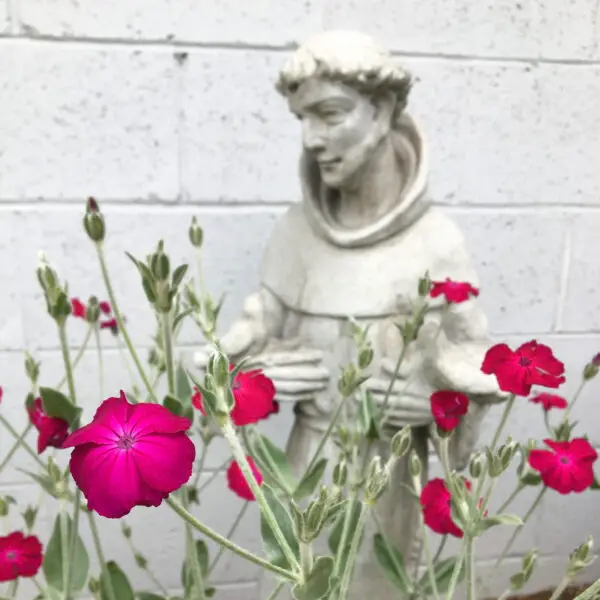
“Lord, make me an instrument of your peace,” the famous prayer of Saint Francis begins. Peacemaking is first the work of Christ. Although violence is the way of the world, Jesus will not rule by it; he will not inaugurate the reign of God by force; he will not command his followers to kill for him. On the contrary, Jesus will submit to violence in order to subvert it. He will establish his authority precisely by refusing to indulge in his adversaries’ killer instincts, and instead will choose the way of sacrificial love. He will absorb the full force of human hostility, succumb to it, and on the third day overcome it.
Then, he’ll invite us into the work, too. “The kingdom of God will be… given to a people that produces its fruits,” Jesus declares, that is, to those who tend the vineyard with consideration and care. “Lord, make me an instrument of your peace.”
Friends, if peace is a gift, peace is also a practice. And if we are instruments, then we’ll need maintenance and regular use. As Walter Wink puts it, we’ll need to “rehearse responding in ways consistent with Jesus’ spirit” in order to be ready when the critical moment arrives. And when it does, God grant us the faith and fortitude to meet it.
Liturgy © 2022 Augsburg Fortress. All rights reserved. Used by permission under OneLicense # A-706920.
Liturgy © True Vine Music (TrueVinemusic.com). All rights reserved. Used by permission under CCLI license #11177466.
“Look who gathers at Christ’s Table”; Text © 2002 Oxford University Press. All rights reserved. Music © 2000 Michael Corzine, admin. Augsburg Fortress
“At the Lamb’s High Feast We Sing”; Arr. © 1969 Concordia Publishing House. Used by permission.
“As We Gather at the Table”; Text © 1989 Hope Publishing Company, Carol Stream, IL 60188. All rights reserved. Used by permission.
“Now We Join in Celebration”; text: Joel W. Lundeen, 1918-1990; music: Johann Crüger, 1598-1662; text © Joel W. Lundeen, admin. Augsburg Fortress. All rights reserved. Used by permission under OneLicense # A-706920.
“Sent Forth by God’s Blessing”; Text © 1964 World Library Publications. 3708 River Road, Suite 400. Franklin Park, IL 60131-2158. www.wlpmusic.com. All rights reserved.