
Home › Sermons › Jesus’ Inheritance, His Treasures, His Jewels
Jesus’ Inheritance, His Treasures, His Jewels
Message for All Saints Day, Year A (11/1/2026)
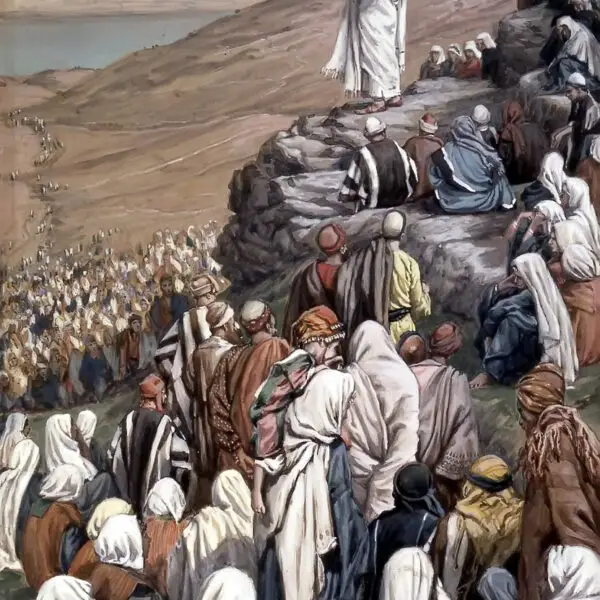
Matthew 5:1-12
The invitation this All Saints Day is to notice whom Jesus notices: Blessed are the poor in spirit, the peacemakers, the persecuted; blessed are the meek, the merciful, the mourners…. These aren’t top of list among those the world commonly calls blessed. The wealthy, the powerful, the highly esteemed– theirs is the kind of blessing we most readily acknowledge.
The author Kurt Vonnegut famously pointed out this disparity in his book A Man Without a Country:
For some reason, the most vocal Christians among us never mention the Beatitudes…. But, often with tears in their eyes, they demand that the Ten Commandments be posted in public buildings…. I haven’t heard one of them demand that the Sermon on the Mount, the Beatitudes, be posted anywhere. “Blessed are the merciful” in a courtroom? “Blessed are the peacemakers” in the Pentagon? Give me a break!
Of course, Jesus is known for turning the world on its head. If the Beatitudes grant favor to those less favored, then blessing is not simply a synonym for comfort. Rather, blessing is divine praxis, an act by which God confers dignity and belonging: “Blessed are the poor in spirit, for theirs is the kingdom of heaven.” That is to say, the Beatitudes invite a new world– the realm of God– where we measure value not by conventional standards, but through the eyes of Christ.
To be a saint, in other words, is to be blessed in Jesus’ sight. As the 17th-century poet Thomas Traherne wrote, “All the Saints of all Ages and all Kingdoms are [Jesus’] inheritance, His treasures, His jewels. Shall they not be yours since they are His whom you love so infinitely?”[1] What a beautiful way to think of the communion of saints in every time and place– together we are Christ’s precious possessions, so we are precious to each other, too.
No one understood this better than Saint Martin de Porres of Peru, whom the church commemorates this Tuesday, November 3rd:
[Martin] was born in 1579 in Lima—his father, Don Juan de Porres, was a Spanish knight who took Martin’s mother, Ana Velazquez, a [formerly enslaved woman] from Panama, as a mistress. Ana had two children by Don Juan—Martin, and his sister, Juana, who were looked down upon and mocked for inheriting their mother’s dark features.
When Don Juan abandoned the family, Ana was left to raise their children on her own. She struggled to support the family by doing laundry…. She had to commit Martin to the care of a school for a few years and then placed him in an apprenticeship with a barber [and surgeon] to learn [to cut hair and practice the medical arts[2]].
Martin spent [many nighttime] hours in prayer and [eventually] heard a call to dedicate his life to God…. By Peruvian law, people of African or indigenous heritage were not allowed to become full members of religious orders…. When he was fifteen, Martin approached the Dominican monastery in Lima to become a donado—a volunteer who took on menial labor and lived with the community….
[He] worked with a willing heart and took upon himself the [tasks] of several servants, tending the laundry and doing kitchen work. Increasingly, Martin was given more and more responsibility. The community entrusted him with distributing food and money to the poor, and he was allowed to use his medical training to assist the sick.
[Despite the law,] eventually [he became] a fully-professed Dominican brother….
Martin wanted to become a foreign missionary but was not allowed to leave the monastery, so he became a missionary in his own city of Lima. He established an orphanage and hospital for abandoned children and reached out to care for [enslaved Africans arriving] in Peru after a miserable journey. Martin often went into the city to care for the sick.
When a dangerous epidemic struck Peru, Martin cared for those who were afflicted, putting his own life at risk. On several occasions, observers saw Martin pass through locked doors to serve [the friars] in quarantine [in the monastery]. [Faced with discipline for violating the community’s rules, he replied, “Forgive my error… for I did not know that the precept of obedience took precedence over that of charity.” Thereafter, he was given full liberty to follow his heart in mercy.[3]]
Martin [also] loved animals—he began a veterinary hospital for dogs and cats and tended to the mice and rats who scampered about the monastery.
St. Martin de Porres is the patron saint of people of mixed race, hair stylists, public schools, and [public health workers]. Because of his [care] for the poor and oppressed, Martin is honored in [a] stained glass window [in] the chapel of Geddes Hall, which houses the Institute for Social Concerns [at the University of Notre Dame]. The institute helps more than 1,000 students each year pursue justice education and partners with 550 community organizations… in 36 U.S. states and 26 countries.[4]
“All the Saints of all Ages and all Kingdoms are [Jesus’] inheritance, His treasures, His jewels”; together we are Christ’s precious possessions, so we are precious to each other, too.
Friends and fellow saints, blessed are you. Since Christ has claimed you as his own, I invite you to claim again today your place in the company of all the saints. God grant you grace to pattern your life on those who’ve gone before you, and to know the inexpressible joys God has prepared for you now and in the time to come.
[1] Cited in Philip H. Pfatteicher, Festivals and Commemorations, 412.
[2] www.catholic.org/saints/saint.php?saint_id=306.
[3] Ibid.
[4] faith.nd.edu/saint/st-martin-de-porres/.
Liturgy © 2022 Augsburg Fortress. All rights reserved. Used by permission under OneLicense # A-706920.
Liturgy © True Vine Music (TrueVinemusic.com). All rights reserved. Used by permission under CCLI license #11177466.