
Message for the Third Sunday of Easter, Year A (4/19/2026)
Acts 2:14a, 36-41, 1 Peter 1:17-23 & Luke 24:13-35
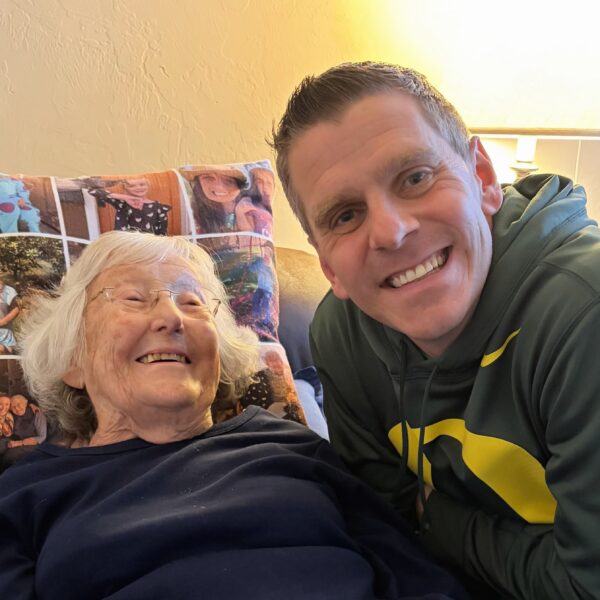
I’ll never forget the counsel Bethany’s grandmother, Shirley, gave me when she learned I was going to seminary. Nate, she said, I need to hear pastors preach from the heart. Always make it from the heart. I knew deep down she wasn’t talking about a kind of saccharine, feel-good message devoid of substance; she didn’t mean I should preach chicken soup for the soul. No, Shirley was expressing the hope that I would meet people at the very core of their humanity, that my ministry would reach that tender internal space where the Spirit can move in life-altering ways. To Shirley, “the heart” was the place of deepest care and transformation.
Three of today’s four assigned scriptures make similar reference to the heart: “The people who hear Peter’s testimony and preaching [in the reading from Acts] are cut to the heart. The writer of 1 Peter instructs believers to love deeply from the heart. [And] the disciples who encounter the risen Christ [in today’s Gospel from Luke] notice afterward that their hearts were ‘burning’ within them as Jesus reveal[ed] the scriptures and then himself to them in the breaking of the bread.”[1]
Easter is an event that takes place at the level of the heart, both individually and collectively. And as such, it makes all the difference: Once distraught, the two disciples rush back from Emmaus with the news of Jesus’ resurrection. Three thousand people are baptized and join the Jesus movement in a single day. Saints in every generation are born anew through the “living and enduring word of God,” and learn to love accordingly.
I love how 19th-century British poet Gerard Manley Hopkins illustrates the heart-changing effect of Easter. In “The Wreck of the Deutschland,” a poem dedicated to the memory of five Franciscan nuns lost at sea, Hopkins famously turns the word Easter into a verb: “Our King… / Let him easter in us, [let him] be a dayspring to the dimness of us….”[2]
That’s good shorthand to describe the experience of those disciples on the road to Emmaus. As they shuffle sadly along, Cleopas and his companion grieve not only the death of their teacher, but also the death of their dreams for the world as he had envisioned it. It wasn’t supposed to be this way, they lament. We had hoped for something else.
Consumed by Good Friday,[3] they can’t imagine the possibility of Easter. Nevertheless, Easter sneaks in beside them. The risen Christ, his identity still hidden from their eyes, lets them voice their pain, listens attentively, then encourages them to consider anew God’s word of hope.
Upon their arrival at Emmaus, the disciples urge him to join them for dinner. And even as begins as a guest, Jesus quickly becomes their host.[4] Blessing and breaking the bread, he is suddenly recognizable to them, then he vanishes as quickly as he arrived. “Were not our hearts burning within us while he was talking to us on the road…?” they marvel. Or to borrow Hopkins’ language, Was he not eastering in us; was he not feeding the flames of our faith?
If God is making all things new, then the Emmaus event is not isolated, but universal. That is to say, the journey to Emmaus is emblematic of every heart-changing experience of Easter. Hear how modern poet, Christian Wiman, reflects on the timelessness of the risen Christ. The following excerpt is from his book My Bright Abyss:
[Excerpt from p. 11]
Friends, where is Christ appearing “calmly and casually” in your life, in the life of our congregation and community, in the life of this weary world? Where is he gently rehabilitating our hope, and feeding us with bread for the journey, only to slip from our grasp and beckon us to find him again in the faces of friends and strangers? Where is he still meeting us at the level of the heart, and changing our lives for the sake of love?
Alleluia, Christ is risen!
[1] Sundays and Seasons Day Resources for the Third Sunday of Easter, April 19th, 2026. Italics mine.
[2] www.poetryfoundation.org/poems/44403/the-wreck-of-the-deutschland.
[3] See Shannon Michael Pater, in Feasting on the Word, Year A, Vol. 2, 418.
[4] See Joel B. Green, The Gospel of Luke, 849.
Liturgy © 2022 Augsburg Fortress. All rights reserved. Used by permission under OneLicense # A-706920.
Liturgy © True Vine Music (TrueVinemusic.com). All rights reserved. Used by permission under CCLI license #11177466.
“Hallelujah! We Sing Your Praises”; text: South African; tr. Freedom Is Coming, 1984; music: South African; arr. Freedom Is Coming; tr. and arr. © 1984 Utryck, admin. Walton Music Corp. All rights reserved. Used by permission under OneLicense # A-706920.
“Baptized in Water”; Text © 1982 by Jubilate Hymns (admin. Hope Publishing Company, Carol Stream, IL 60188). All rights reserved. Used by permission.
Arr. © 2006 Augsburg Fortress
“Come Let Us Eat”; Text sts. 1-3 and tune © Lutheran World Federation; text st. 4 and adapt. © 1972 Contemporary Worship 4, admin. Augsburg Fortress
“Touch That Soothes and Heals”; Text © 2002 GIA Publications, Inc., giamusic.com. All rights reserved.
Music © 2008 Re:Create Music, admin. Faith Alive Christian Resources