
Message for the Eighteenth Sunday after Pentecost, Year A (9/27/2026)
Philippians 2:1-13 & Matthew 21:23-32
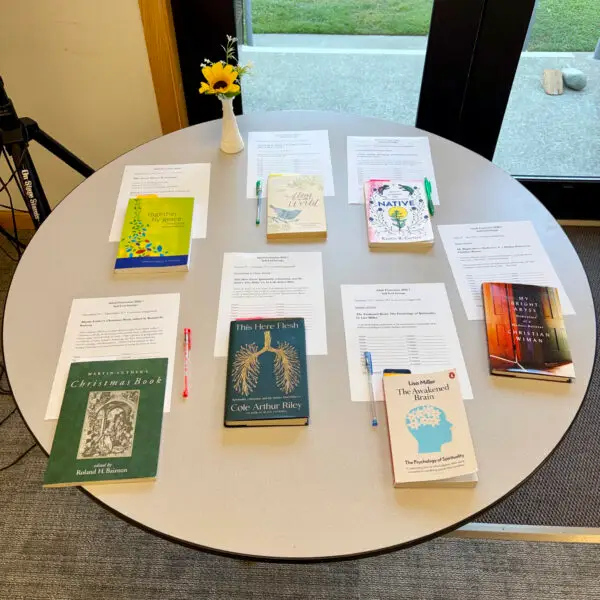
One of my favorite spiritual practices is to read interesting books and think and talk about my reading. Of course, I invite you to read along, so I’ve chosen a new series of titles for self-selected and self-led book study this year. Take a look at the table in the Gathering Area, see if anything strikes your fancy, and sign up for a study group!
I can’t promise the ideas you encounter in your reading will be easy. Recently, one of you approached me with a sincere question: “These books you ask us to read, are they… approved by the synod?” The answer is no, there isn’t an authorized list of resources; neither is there a list of banned books. So for better or worse, we’re on our own! I’m fond of saying we don’t need to be afraid of ideas, so we can read with good courage. And I trust you who participate in book studies will raise your honest questions and concerns with each other, and to reach out for support as needed.
Nonetheless, the question about synod-approved books points to a legitimate concern. Who gets to decide how we think about faith and life? What are the criteria? What is acceptable, and what is out of bounds? And if we were to depart from the authorized resources, what might the consequences be?
“By what authority are you doing these things,” the chief priests and elders ask Jesus in today’s Gospel, “and who gave you this authority?” This question isn’t a surprise coming from the keepers of the religious status quo. It’s pointed: “By what authority are you doing these things,” that is, Where do you get off upsetting the apple cart with your newfangled teaching and healing and vision for abundant life? Our legitimacy is based on generations of standard practice. What about yours?
True to form, Jesus doesn’t acquiesce to their demand for a straightforward answer. But we who have read the Gospel from the beginning are in the know: “Joseph, son of David,” the angel calls in a dream, “do not be afraid to take Mary as your wife, for the child conceived in her is from the Holy Spirit…. He will save his people from their sins.”[1] Only two chapters later, another heavenly voice rings out over the River Jordan: “This is my beloved Son, with whom I am well pleased.”[2] Jesus is no upstart, no self-aggrandizing pretender; he is none other than Emmanuel, God-with-us. So his project to repair the world carries nothing less than divine authority.
Still, the question of authority arises in every age. At every turning point in the church’s history, we’ve had to answer it again in order to regain our bearings. In conflict with the 16th-century Christian establishment, for instance, Martin Luther and his fellow reformers came to a decisive conclusion: Sola scriptura– scripture alone has authority. “No more Pope, no more magisterium, no more human confessor between humanity and… God, only the Good Book,” as historian Phyllis Tickle puts it.[3]
But five hundred years later, in another era of great change for the church, the authority of scripture is in question. Tickle observes that in the present age, “all writing– be it sacred or secular– has no innate meaning until it is read,”[4] which is to say final authority rests with the reader; interpretation is everything.
And to complicate matters, we live in a pluralistic world in proximity to neighbors of diverse backgrounds. Tickle explains:
[Excerpt from The Great Emergence, pp. 132-3]
All to say that authority is no longer granted by virtue of tradition; rather, authority is earned. We gain the trust of our neighbors by being trustworthy conversation partners. And, as in Jesus’ parable of the sons who do or do not follow their father’s direction to go to work in the field, it’s a question of integrity: actions speak louder than words.
Who has authority to speak and act on behalf of God? Maybe the answer to that question has something to do with the Apostle Paul’s teaching in today’s reading from Philippians: “Be of the same mind, having the same love, being in full accord and of one mind…. Let each of you look not to your own interests but to the interests of others. Let the same mind be in you that was in Christ Jesus….”
Friends, where do you perceive the influence of Christ most clearly? Where is his gift of grace received and shared most readily? Whom do you trust to look to your interests and those of the least among us? What does love of God and neighbor look like in actuality? That’s the kind of servant leadership that warrants our attention and respect. That is an authority worthy of our allegiance.
[1] 1:20-21.
[2] 3:17.
[3] The Great Emergence, 45-6.
[4] Ibid. 79.
Liturgy © 2022 Augsburg Fortress. All rights reserved. Used by permission under OneLicense # A-706920.
Liturgy © True Vine Music (TrueVinemusic.com). All rights reserved. Used by permission under CCLI license #11177466.
“Welcome Table”; Arr. © 2003 Augsburg Fortress
“Here on Jesus Christ I Will Stand”; Text © 2007 East African Annual Conference, admin. General Board of Global Ministries, GBGMusik
English adapt. and arr. © 2007 Greg Scheer, admin. General Board of Global Ministries, GBGMusik
“Lord Listend to Your Children Praying”; Text and music © 1973 Hope Publishing Company, Carol Stream, IL 60188. All rights reserved. Used by permission.
“Lord, Whose Love in Humble Service”; text: Albert F Bayly, 1901-1984, © Oxford University Press; music: The Sacred Harp, Philadelphia, 1844; arr. Selected Hymns, 1985, © 1985 Augsburg Fortress. All rights reserved. Used by permission under OneLicense # A-706920.
“The Lord Now Sends Us, Forth”; English text © 1998 and arr © 2003 Augsburg Fortress
Your Grace Is Enough with Grace Greater than Our Sin/Matt Maher/arranged by Carol Tornquist/copyright 2012 Word Music, LLC/CCLI