
Message for the Sixteenth Sunday after Pentecost, Year A (9/13/2026)
Psalm 103:1-13 & Matthew 18:21-33[1]
There’s a danger in drawing too close a parallel between the most powerful figure in any parable and God. That’s precisely what Matthew does at the end of today’s Gospel, two verses I intentionally omitted from the reading (although if you’re curious enough, you’ll look up verses 34 and 35 after worship). Suffice it to say, Jesus’ parables don’t always translate into neat allegories. In fact, some scholars believe that Matthew’s allegorical interpretation of this one– God is the king, we are the slaves– departs from the original intent. For Jesus, the king in the story is a Gentile tyrant who forgives a debt unexpectedly, making his former debtor’s cruelty all the more striking.[2]
If we force Matthew’s allegorical categories onto the parable, that is, if we read his ending in verses 34 and 35, we might draw some troubling conclusions about God. Instead, today we’ll let Jesus’ parable speak on its own terms. What does Jesus mean to communicate through the story of the king, his debtor, and his debtor’s debtor? What do the interactions between these characters have to say about the function of forgiveness?
A word about the numerical figures is in order. Ten thousand talents, the debt the king forgives his slave, is an absurd amount. A single talent is equal to fifteen years’ wages for a manual laborer. Ten thousand of them would exceed the total tax burden for all of Syria, Phoenicia, Judea, and Samaria. That is to say, the slave’s debt is unimaginable, as is the king’s decision to forgive it, which makes the slave’s heartlessness absurd, too. The debt the second slave owes is a fraction of the first, although it’s not insignificant either– a hundred denarii represents over three months’ wages for a worker.[3] Having been so extravagantly forgiven, shouldn’t the first slave naturally forgive the second? If he grasps the magnitude of the king’s mercy, in other words, shouldn’t he practice corresponding mercy? Grace ought to engender grace.
Of course, in this story, it doesn’t. The first slave condemns the second to prison, and in so doing infuriates his neighbors. But is his behavior as shocking as it may seem at first? Doesn’t his refusal to forgive reflect the norm? “Lord,” Peter asks at the outset of today’s Gospel, “how often should I forgive? As many as seven times?” Stated another way, Peter’s question reveals the heart of his concern: “Lord, when can I stop forgiving?”[4] That feels closer to the truth.
Aren’t we inclined to withhold forgiveness, and instead keep score? Don’t we tend to measure our neighbors’ debts, as it were, and track their accountability? Forgiveness threatens to remove a so-called debtor’s responsibility, and that simply cannot stand.
Moreover, if we do forgive, we do so conditionally. We forgive only if a debtor fulfills certain criteria, for instance, demonstrating remorse, accepting a penalty, or promising to change. Conditional forgiveness is attractive because, again, it gives us the upper hand, gratifying the impulse to keep a balance sheet. It reinforces the idea that mercy is earned, and that we’re in a position to evaluate a person’s worthiness to be forgiven.
“Not seven times,” Jesus replies to Peter’s question, “but, I tell you, seventy-seven times.” An alternate translation has that number at seventy times seven, or four hundred ninety. Either way, the point is clear: Stop counting, Peter. Forgiveness has no limit.
In other words, Jesus redefines forgiveness according to the divine standard. To borrow language from the psalm, “The LORD is merciful and gracious, slow to anger and abounding in steadfast love.” God does not deal with us “according to our sins,” even as we hold them against each other. “For as the heavens are high above the Earth, so great is God’s steadfast love…. As far as the east is from the west, so far God removes our transgressions from us.”
Divine mercy is simply not a matter of calculation. One interpreter puts it this way:
“Seventy-seven” is biblical code for eternal completeness. In other words, there is no limit to forgiveness inside the Kingdom. God doesn’t merely dole out mercy, as if it were a limited commodity to be dispensed when feeling especially generous. [No,] God is mercy, and forgiveness is the operating system of God’s Kingdom.[5]
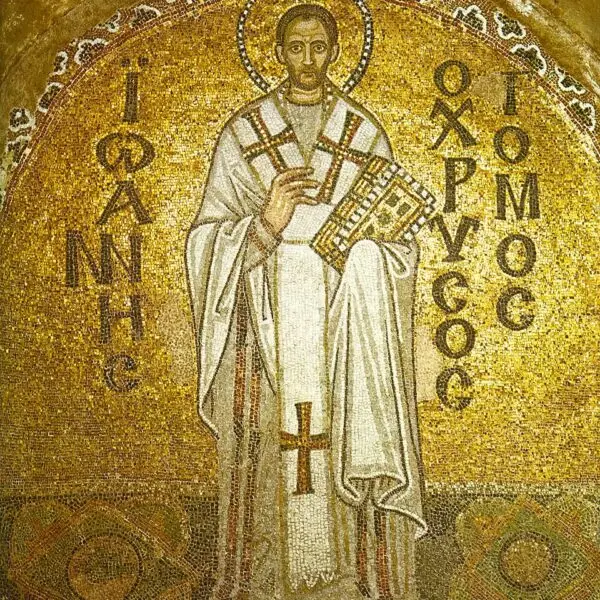
Today, the church commemorates Saint John Chrysostom, Bishop of Constantinople, who was renowned not only for his preaching but also his vocal criticism of imperial corruption. In the year 403 CE, the Empress Eudoxia, formerly his admirer, conspired to have John banished from the city.[6] John had as much reason as any saint in history to hold a grudge against his persecutors. Nevertheless, he held to the following principle: “If we must remember offenses, let us remember only our own…. Let us be zealous in nothing so much as in keeping ourselves free from anger and from not seeking to be reconciled with those who are opposed to us.”[7]
The tragedy of unforgiveness, friends, is that we inhabit a world of stingy record-keeping, which becomes a prison of our own making. God is mercy, and in the end, mercy is liberating. As Rob Bell puts it, “To forgive is to set someone free and then find out that it’s you.”
[1] Verses 34-5 are intentionally omitted.
[2] The New Interpreter’s Bible, Vol. VIII, 381.
[3] Ibid. 382.
[4] Kathryn D. Blanchard, in Feasting on the Word, Year A, Vol. 4, 68.
[5] streetpsalms.org/proper-19-24-year-a/.
[6] Philip H. Pfatteicher, Festivals and Commemorations, 349.
[7] John Chrysostom, in The Sunday Sermons of the Great Fathers, Vol. IV, 289.
Liturgy © 2022 Augsburg Fortress. All rights reserved. Used by permission under OneLicense # A-706920.
Liturgy © True Vine Music (TrueVinemusic.com). All rights reserved. Used by permission under CCLI license #11177466.
“Ten Thousand Reasons”; Text and music © 2011 Thankyou Music (PRS) / Atlas Mountain Songs (BMI) / worshiptogether.com Songs (ASCAP) / sixsteps Music (ASCAP), admin. CapitolCMGPublishing.com. All rights reserved.
“Here on Jesus Christ I Will Stand”; Text © 2007 East African Annual Conference, admin. General Board of Global Ministries, GBGMusik
English adapt. and arr. © 2007 Greg Scheer, admin. General Board of Global Ministries, GBGMusik
“Taste and See”; text: James E. Moore Jr., b. 1951, based on Ps. 34; music: James E. Moore Jr.; text and music © 1983 GIA Publications, Inc. All rights reserved. Used by permission under OneLicense # A-706920.
“God’s Work, Our Hands”; Text © 2019 Evangelical Lutheran Church in America, admin. Augsburg Fortress
Music © 1968 Augsburg Publishing House, admin. Augsburg Fortress
“I Come with Joy”; text: Brian A. Wren, b. 1936; music: W. Walker, Southern Harmony, 1835; text © 1971, rev. 1995 Hope Publishing Company. All rights reserved. Used by permission under OneLicense #A-706920.